

Value driven AI is a strategic approach that starts with specific business outcomes and aligns all AI development, data, and processes to achieve measurable results—rather than simply adopting AI technology for its own sake.
- Business-first thinking: Start with the outcome you want (increased revenue, better customer experience, lower costs) rather than the technology itself
- Outcome alignment: Connect every AI initiative directly to measurable business metrics
- Full lifecycle management: Move AI from pilot projects to scaled production systems that deliver consistent value
- Integration with value streams: Embed AI into the core processes that deliver products and services to customers
- Trust and governance: Build ethical frameworks that increase adoption and minimize risk
We’re at a crossroads with AI. Nearly half of all AI projects fail to make it from pilot to production, and Gartner predicts that at least 30% of generative AI projects will be abandoned after proof of concept by the end of 2025. The culprit? A lack of clarity around business value.
While 88% of organizations now report regular AI use in at least one business function, most are still stuck in the experimentation phase. The gap between AI adoption and AI value is widening. Companies pour resources into impressive technology demonstrations that never translate into improved profit margins, streamlined operations, or better customer experiences.
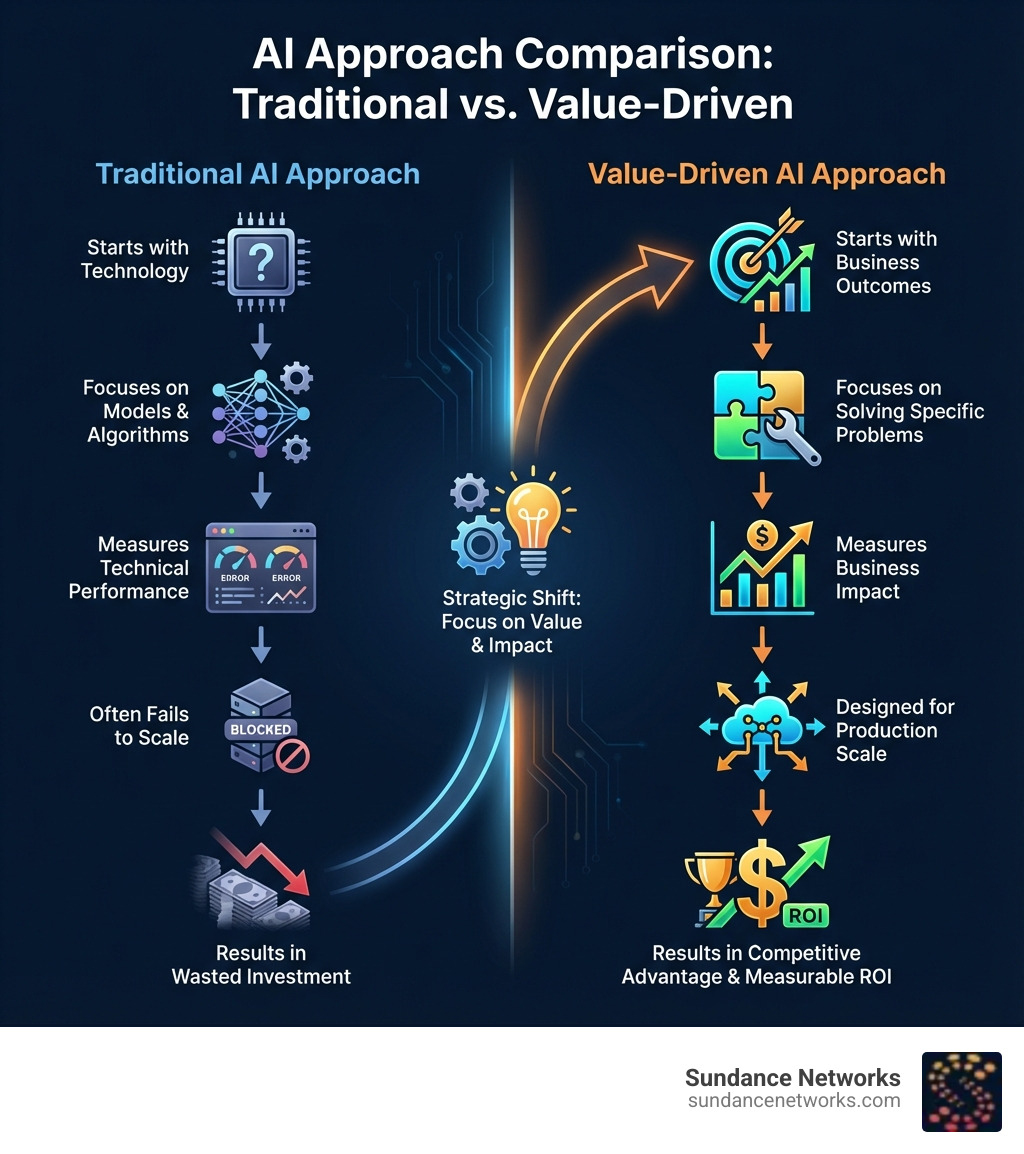
The problem isn’t the technology itself—it’s the approach. Traditional AI implementations focus on algorithms, models, and technical capabilities first, then hope business value will follow. Value-driven AI flips this equation entirely. It starts with the business outcome you need and works backward to determine how AI can help you get there.
This shift matters because organizations taking a value-first approach are seeing dramatically different results. Three-quarters of extensive AI adopters now believe AI is enabling new sources of value and competitive advantage. High performers are more than three times as likely to say their organizations intend to use AI to bring about transformative change to their businesses, not just incremental efficiency gains.
The difference comes down to focus. Brooklyn IT automation treats artificial intelligence as a tool to solve specific business problems—reducing customer churn, accelerating product development, or optimizing supply chains—not as a goal in itself. It requires rethinking workflows from the ground up, establishing clear governance, and measuring success by tangible business metrics rather than technical benchmarks.
I’m Ryan Miller, founder of Sundance Networks, and over my 17+ years in information technology and security, I’ve helped organizations cut through the hype to implement Value driven AI solutions that deliver measurable business impact. Let me show you how to make AI work for your bottom line, not just your tech stack.
What is Value-Driven AI and Why Does it Matter?

The core concept of Value-Driven AI is beautifully simple: it’s about making AI work for your business objectives, not the other way around. Unlike traditional AI approaches that often prioritize technological prowess or simply automating existing tasks, Value-Driven AI begins with a clear understanding of what constitutes “value” for your organization and your customers. This means we focus on desired business outcomes like increased profitability, improved customer satisfaction, or improved operational efficiency, and then strategically deploy AI to achieve these specific, measurable goals.
How does this differ from traditional AI? Traditional AI often sees projects flounder because they lack a strong connection to tangible business results. We’ve all heard the statistics: on average, 54% of AI projects never make it from pilot to production. This often happens when the focus is purely on the AI model’s accuracy or complexity, rather than its real-world impact. Value-Driven AI shifts this paradigm, ensuring every AI initiative is a strategic investment designed to yield a clear return. It’s about moving beyond experimentation to achieving measurable, impactful results that drive competitive advantage.
The Shift from Technology-First to Value-First
For too long, the narrative around AI has been technology-first. Businesses would invest in the latest AI tools because “everyone else was,” or because the technology itself was fascinating. This often led to solutions in search of problems, with AI being implemented for technology’s sake rather than as a strategic lever for business growth.
Value-Driven AI represents a crucial shift. It dictates that we start by asking: “What business problem are we trying to solve?” or “What new value can we create for our customers?” Only then do we consider how AI can be the most effective tool to achieve that. This customer-centric and outcome-focused approach is why three-quarters of extensive AI adopters now believe AI is enabling new sources of value and competitive advantage. They’re not just adopting AI; they’re aligning it directly with their strategic business goals.
The High Cost of Unaligned AI
The consequences of a technology-first approach are costly. Gartner’s prediction that at least 30% of GenAI projects will be abandoned after proof of concept by the end of 2025 highlights a widespread issue: wasted investment. This abandonment often stems from a lack of clarity around business value, brittle tooling, data silos, and governance blind spots that make scalable, continuous, and explainable success nearly impossible.
When AI projects fail to deliver tangible value, it’s not just a financial drain; it erodes confidence, wastes precious time, and can stifle future innovation. This is why a new approach is imperative. We believe in building robust AI Solutions: A Practical Guide for Businesses That Want to Work Smarter, Not Harder that are inherently value-driven, designed to overcome these common pitfalls and ensure your AI investments truly pay off.
The Blueprint: Integrating AI into Business Value Streams
To truly open up AI’s potential, we must integrate it where value is created and delivered: within your business value streams. A value stream, rooted in Lean, Six Sigma, and Agile methodologies, is the entire sequence of steps that an organization takes to deliver a product or service to a customer. By focusing on these streams, we can improve operational excellence and drive customer-centric change.
How can organizations leverage value streams to improve their AI initiatives and achieve tangible business outcomes? By strategically embedding AI at various points to improve data integration, analysis, and automation, we can eliminate waste, accelerate processes, and deliver superior customer experiences.
How AI Boosts Value Stream Analysis
AI plays a transformative role in improving data integration, analysis, and automation within value streams. Think of it as giving your value streams a superpower:
- Data Integration: AI can seamlessly integrate disparate data sources across your value stream, breaking down silos and creating a unified view of operations. This allows for a more comprehensive understanding of where inefficiencies lie.
- Real-time Monitoring and Insights: AI-powered analytics can monitor value stream performance in real-time, identifying bottlenecks, anomalies, and opportunities for improvement as they happen. This enables proactive decision-making rather than reactive problem-solving.
- Predictive Analytics: By analyzing historical data, AI can predict future trends, customer needs, and potential disruptions within the value stream. This allows for optimized resource allocation, proactive maintenance, and more accurate forecasting.
- Process Automation and Optimization: AI can automate repetitive tasks, optimize process flows, and even suggest improvements to workflows, leading to significant gains in efficiency and cost reduction. This is where AI truly transforms operations, as we discuss in How Automation Transforms Managed Services for Small and Medium Businesses.
- Personalized Recommendations: For customer-facing value streams, AI can analyze customer data to provide personalized product recommendations, service offerings, and support, enhancing the overall customer experience and driving loyalty.
AI-powered value stream analysis leads to a more customer-centric change for businesses. By understanding and optimizing every step of the customer journey, we can tailor experiences, anticipate needs, and deliver exceptional value, ensuring our customers in Stroudsburg, PA, Reading, PA, Santa Fe, NM, Allentown, PA, Albuquerque, NM, and Rio Rancho, NM receive the best possible service.
Practical Steps for AI-Powered Value Stream Mapping
Implementing AI within your value streams requires a structured approach. Here are the practical steps we recommend:
- Define Value from the Customer’s Perspective: Begin by clearly articulating what value means to your customer. What problems are you solving? What outcomes are they seeking? This customer-centric view is paramount for a successful Value-Driven AI strategy.
- Map the Current State Value Stream: Visually map out every step, from initial customer request to final delivery. Identify all activities, resources, lead times, and decision points. This helps us understand the “as-is” state.
- Identify Bottlenecks and Opportunities for AI: Analyze the current state map to pinpoint areas of waste, delay, manual effort, and inconsistent quality. These are prime candidates for AI intervention, whether through automation, predictive insights, or improved analysis.
- Design the Future State with AI Integration: Reimagine your value stream with AI strategically embedded. How can AI eliminate bottlenecks, accelerate processes, or improve decision-making? Focus on the desired outcomes and how AI can achieve them.
- Implement and Continuously Improve: Deploy your AI-improved value stream, starting with pilot projects if necessary. Crucially, establish metrics to monitor performance and create a feedback loop for continuous learning and optimization.
Overcoming Problems: A Practical Guide to Implementing Value-Driven AI
Implementing Value-Driven AI isn’t without its problems, but with the right strategy, these challenges can be transformed into opportunities. Organizations often face a range of issues, from internal resistance to technical complexities. However, by understanding these challenges and focusing on critical success factors, we can steer the path to successful AI adoption and deliver meaningful impact.
Key Challenges in Implementing Value-Driven AI
When we work with businesses in areas like Allentown, PA, and Albuquerque, NM, we often encounter similar challenges:
- Organizational Silos: Departments operating independently can hinder data sharing and cross-functional collaboration, which are essential for holistic AI solutions.
- Lack of Clear Business Case: Without a well-defined problem to solve or a clear ROI, AI projects can quickly lose funding and executive support.
- Talent Gaps: A shortage of skilled AI professionals, data scientists, and engineers, as well as a lack of AI literacy among existing staff, can slow progress.
- Data Quality Issues: AI models are only as good as the data they’re fed. Incomplete, inconsistent, or biased data can lead to inaccurate insights and poor decisions.
- Measuring ROI: Quantifying the exact return on AI investment can be complex, especially for initiatives that deliver intangible benefits like improved customer satisfaction.
- Building Trust: Concerns about AI’s fairness, transparency, and potential for bias can create internal resistance and slow adoption.
Critical Success Factors for a Value-Driven Culture
Overcoming these challenges requires more than just technical expertise; it demands a cultural shift and strategic leadership. Here are the critical success factors we’ve identified for organizations aiming to become value-driven and customer-centric through AI:
- Senior Leadership Ownership and Commitment: AI initiatives thrive when championed from the top. Leaders must demonstrate unwavering commitment and integrate AI into the overall business strategy.
- Cross-Functional Collaboration: Break down silos by fostering collaboration between IT, business units, and data science teams. This ensures AI solutions address real-world problems and are adopted effectively.
- Agile Product Delivery: Accept agile methodologies for AI development. This allows for rapid experimentation, iterative improvements, and quicker realization of value.
- Investing in Talent and Training: Address talent gaps by hiring skilled professionals and, crucially, upskilling your existing workforce in AI concepts and applications.
- Establishing a Robust Data Foundation: Prioritize data quality, governance, and accessibility. A clean, well-managed data infrastructure is the bedrock of effective AI.
- Business-Led Change: As the research with MIT suggests, 70% of AI change effort should focus on people and processes. Business leaders, in partnership with IT, must lead the charge to ensure AI solves the right problems and drives real value. This often involves Custom IT Consulting & System Integration to align technology with strategic goals and ensure The Managed IT Necessity: Why Your Business Needs a Smarter IT Strategy is met.
The Next Frontier: How Agentic AI Delivers Unprecedented Value
As AI continues to evolve at breakneck speed, a new paradigm is emerging that promises to deliver even more profound value: Agentic AI. This isn’t just about AI that can predict or generate; it’s about AI that can observe, plan, and act autonomously to achieve specific goals, embedding institutional knowledge and changing entire workflows. This shift is so significant that our research with MIT reveals it will radically alter the traditional enterprise operating model.
What is Agentic AI?
Think of Agentic AI as the “frontal cortex” of artificial intelligence. While predictive AI uses logic and optimization, and generative AI excels at creativity and synthesis, agentic AI serves as the executive function. It takes on entire workflows, applying judgment shaped by your company’s proprietary intelligence and institutional knowledge. It observes, plans, and acts on its own, learning continuously and embedding itself into your business processes to execute tasks that traditionally slow organizations down.
This isn’t a futuristic concept; it’s happening now. A significant 35% of organizations are already using agentic AI, with another 44% planning to do so soon. Furthermore, 23% of respondents report their organizations are scaling an agentic AI system somewhere in their enterprises.
Practical applications are already demonstrating immense value:
- Improved Sales: A telecommunications company saw a fivefold jump in digital sales after deploying agentic assistants to manage customer interactions.
- Streamlined Payroll: A payroll provider improved processing speed by over 50% through automated anomaly resolution handled by agentic systems.
- Accelerated Design: A shipbuilder cut engineering efforts by approximately 40% and design/engineering lead time by 60% using agents to run multi-step design processes.
These examples, from various industries, highlight how agentic AI moves beyond simply assisting humans to actively executing complex, multi-step processes, delivering unprecedented value and competitive advantage.
The Implications of Agentic AI for Business Processes
The rise of agentic AI has profound implications for how we structure work and organizations. It’s not just about automating tasks; it’s about fundamentally reshaping business processes:
- Workforce Rebalancing: We will likely see a rebalancing of the workforce. Instead of entry-level roles focused on routine execution, junior talent may transition to directing agentic AI, with a greater demand for generalists managing human-agent teams.
- Reduced Middle Management: As AI agents handle routine execution and orchestration, the need for some middle management layers may decrease, freeing up human talent for more strategic, outcome-driven roles.
- Shift to Outcome-Driven Teams: Organizations will increasingly move towards cross-functional, outcome-driven teams overseeing AI, rather than managing discrete tasks.
- Graduated Autonomy Framework: Building trust in agentic AI is paramount. We recommend a “graduated autonomy framework,” where AI agents earn increasing levels of autonomy (from “Shadow Mode” where humans supervise, to “Full Autonomy” where humans are out of the loop) through proven performance and rigorous testing. This builds confidence and ensures responsible deployment.
Embracing agentic AI requires a proactive approach to organizational design and talent development. It’s about empowering your teams to work smarter, not harder, and leveraging advanced AI to drive efficiency and innovation. For many businesses, particularly small and medium-sized ones, this can be a game-changer, making it even more compelling to consider Why Small Businesses Should Outsource Information Technology Services to gain access to this specialized expertise.
Measuring What Matters: ROI and Ethical Governance
For any investment, especially in transformative technology like AI, demonstrating a clear return on investment (ROI) is crucial. With Value-Driven AI, measuring ROI goes beyond simple cost savings; it encompasses a broader spectrum of benefits, including revenue growth, customer satisfaction, and innovation. Equally important are the ethical considerations and governance frameworks that ensure our AI systems are trustworthy, fair, and responsible.
How to Measure the ROI of Your Value-Driven AI
Measuring the ROI of Value-Driven AI requires a holistic approach that links AI initiatives directly to key business metrics. Our AI Impact Calculator is designed to help you quantify these benefits, which often include:
- Revenue Growth: AI can directly contribute to increased sales through personalized marketing, optimized pricing, and new product development.
- Customer Lifetime Value (CLV): By enhancing customer experience and satisfaction through AI-powered personalization and efficient service, we can significantly boost CLV.
- Employee Productivity: Automating repetitive tasks and providing intelligent assistance frees up employees to focus on higher-value activities, improving overall productivity.
- Innovation Rate: AI can accelerate research and development, leading to faster time-to-market for new products and services.
- Cost Savings: While not the sole focus, AI certainly drives cost reductions through process optimization, reduced errors, and efficient resource allocation.
By tracking these metrics, we can clearly demonstrate the tangible impact of our Value-Driven AI investments, moving beyond mere technical performance to show real business value.
Ethical Frameworks for Value-Driven AI
The ethical implications of AI are not just philosophical debates; they are critical business considerations. Trust is a powerful business asset, and untrustworthy AI can undermine even the most robust business case. New research from IBM highlights this, showing that organizations in the top quartile of AI ethics spending demonstrate 30% higher operating profit attributable to AI than the lowest quartile.
However, the path to ethical AI is not always smooth. More than half of executives cite ethics-oriented concerns as key barriers to AI adoption, and 53% of organizations find their AI ethics governing bodies ineffective. This underscores the need for robust ethical frameworks and governance.
We believe that implementing trustworthy Value-Driven AI requires:
- Transparency and Explainability: Ensuring that AI decisions can be understood and justified, reducing concerns about “black box” algorithms.
- Fairness and Bias Mitigation: Actively working to identify and eliminate biases in data and algorithms to ensure equitable outcomes for all users.
- Privacy and Security: Protecting sensitive data and ensuring AI systems are secure against cyber threats. This aligns with our comprehensive Managed Services and Security offerings.
- Human Oversight: Maintaining human accountability and intervention capabilities, especially for critical decisions.
- Robust Governance Frameworks: Establishing clear policies, procedures, and oversight bodies to guide AI development and deployment. Google, for example, outlines comprehensive AI Principles that guide their development, emphasizing responsible deployment and collaborative progress.
By integrating these ethical considerations into every stage of our AI initiatives, we not only mitigate risks but also build trust, improve our brand reputation, and ultimately open up greater business value from our Value-Driven AI solutions.
Frequently Asked Questions about Value-Driven AI
How is Value-Driven AI different from just “using AI in business”?
Value-Driven AI is a strategic framework that starts with a specific business outcome and aligns all AI development, data, and processes to achieve it. It contrasts with simply adopting AI tools without a clear connection to measurable value, which often leads to failed projects. While “using AI in business” might imply implementing AI for its own sake or for incremental efficiency, Value-Driven AI demands that every AI initiative directly contributes to a defined, measurable business objective, ensuring a tangible return on investment.
What is the first step to becoming a value-driven organization with AI?
The first step is to define what “value” means for your business and customers. This involves identifying key business objectives and mapping your operational value streams to understand where AI can have the most significant impact on efficiency, cost reduction, or customer experience. Without this foundational understanding, AI implementations risk becoming costly experiments rather than strategic investments.
Can small businesses implement Value-Driven AI?
Yes, absolutely! The principles of Value-Driven AI are scalable and highly beneficial for small businesses. Small businesses can start by focusing on a single, high-impact area, such as automating customer service inquiries, optimizing inventory management, or personalizing marketing campaigns. By using accessible AI tools to solve that specific problem with a clear outcome in mind, they can ensure a measurable return on their investment without needing massive resources. The key is focus and a clear definition of value.
Making AI Your Most Valuable Asset
We’ve seen how integrating AI into value streams can drive operational excellence and customer-centric change, and how agentic AI represents the next frontier in autonomous, intelligent business processes. Critically, we’ve underscored the necessity of measuring ROI comprehensively and embedding ethical governance and security through proactive Brooklyn tech support to build trust and maximize value.
At Sundance Networks, we believe AI should be your most valuable asset, a strategic partner in achieving your business goals. Our approach ensures that every AI solution we implement for our clients in NM, PA, and NY.
Don’t let your AI initiatives fall into the 54% that fail to reach production. Whether you’re exploring IT consulting in Brooklyn or scaling advanced AI capabilities across your organization, partner with us to build a future where AI drives real value for your business.