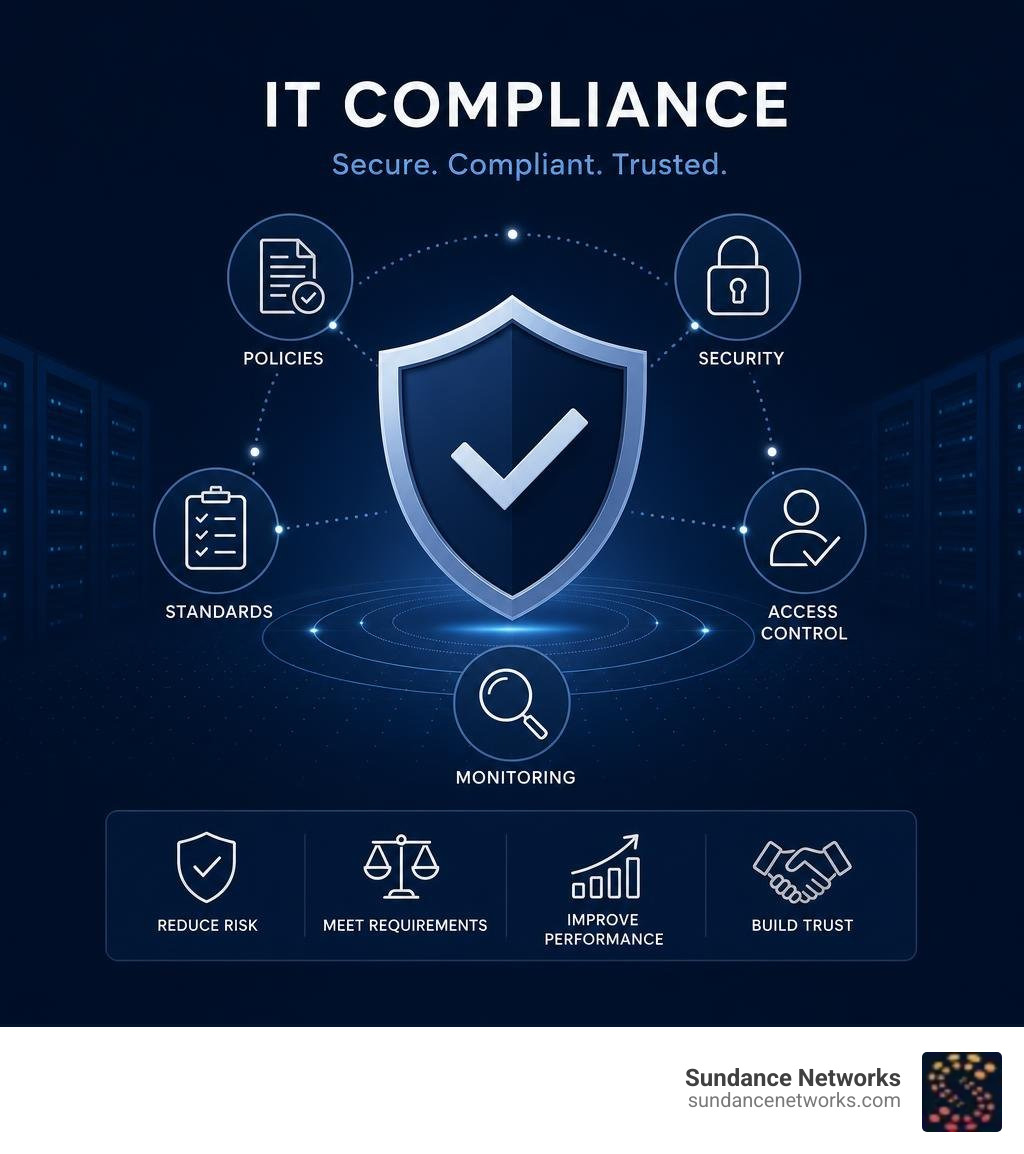
IT compliance is the process of ensuring your organization’s technology systems, data practices, and operations meet the requirements set by relevant laws, regulations, and industry standards.
In plain terms, it means:
- Following rules like HIPAA, GDPR, or PCI DSS that apply to your industry
- Putting technical controls in place to protect sensitive data
- Documenting policies, audits, and procedures to prove you’re doing it
- Reducing the risk of fines, breaches, and legal liability
Think of it like workplace safety rules — but for your digital environment. Just as a factory posts hazard signs and requires hard hats, IT compliance requires your systems to be built and maintained in ways that protect people’s data and your organization’s integrity.
Without a solid compliance strategy, the risks are real: security breaches, regulatory fines, damaged customer trust, and operational disruptions. And in 2026, those rules are growing — not shrinking.
The good news? Compliance doesn’t have to be overwhelming. With the right framework and tools, it becomes a manageable — and even competitive — advantage.
I’m Ryan Miller, founder of Sundance Networks, and with over 17 years of experience in information systems and more than a decade specializing in information security, I’ve helped businesses across healthcare, finance, and professional services navigate IT compliance requirements without losing sight of their core operations. In this guide, I’ll break down everything you need to know — from key standards to practical steps you can take today.
Basic IT compliance terms:
- Future proof technology
- HIPAA compliance consulting
- IT consulting support
Understanding IT Compliance and Its Importance in 2026
As we navigate through 2026, the digital landscape has become more complex than ever. IT compliance is no longer just a “check-the-box” activity performed once a year; it is a fundamental pillar of modern business operations. At its core, compliance is about adhering to established rules, standards, or specifications to align with government expectations and industry best practices.
Why should your organization prioritize this? First and foremost, it offers legal protection. Regulatory bodies provide detailed guidelines for every rule, and failing to follow them can lead to devastating lawsuits or government intervention. Beyond avoiding the “stick” of legal trouble, compliance provides the “carrot” of operational efficiency. By standardizing your IT processes, you reduce the “spaghetti code” of haphazard configurations, making your systems easier to manage and scale.
Furthermore, reputation management is critical. In an era where data breaches make headlines daily, showing your clients that you meet rigorous standards like SOC 2 or ISO 27001 builds immense trust. It signals that you take data integrity seriously. Whether you are operating in Stroudsburg, PA, or Santa Fe, NM, your customers want to know their sensitive information is handled with care. To dive deeper into why professional guidance is often necessary for these complex rules, see our article on Compliance and IT Regulation: Why Your Business Needs Expert Help.
IT Compliance vs. IT Security: Key Differences
It is a common misconception that being “secure” means you are “compliant,” or vice versa. While they are closely related, they serve different masters. We like to say that compliance is the floor, while security is the ceiling.
| Feature | IT Compliance | IT Security |
|---|---|---|
| Primary Goal | Meeting external regulatory requirements and standards. | Protecting assets from threats and vulnerabilities. |
| Driven By | Laws, regulations, and industry mandates (e.g., HIPAA). | Risk assessments and the evolving threat landscape. |
| Focus | Data protection, privacy, and auditability. | Proactive defense, detection, and response. |
| Enforcement | Legal penalties, fines, and loss of certification. | Operational downtime, data loss, and breach costs. |
| Nature | Often prescriptive (do X, Y, and Z). | Strategic and adaptive (continuous improvement). |
IT compliance establishes the minimum requirements your business must meet to operate legally within your sector. IT security, on the other hand, goes beyond those minimums to manage real-world risks. Think of compliance as the “what” (what rules must we follow?) and security as the “how” (how do we actually stop the hackers?). They have a synergistic relationship: security measures enable you to achieve compliance, while compliance frameworks provide a structured roadmap for your security strategy. For businesses looking to align these two worlds, our Regulatory Services can help bridge the gap.
Major IT Compliance Standards and Regulations
Depending on your industry and where you do business, you may be subject to several different frameworks simultaneously. Here are the heavy hitters we see most often in 2026:
- GDPR (General Data Protection Regulation): This applies to any company handling EU citizens’ data, regardless of where the company is located. If you have a customer in Paris but your office is in Allentown, PA, GDPR still applies to you.
- HIPAA (Health Insurance Portability and Accountability Act): The gold standard for healthcare. It sets strict requirements for protecting sensitive patient data (PHI). If you’re in the medical field, you should check out The Anatomy of a Compliant Practice: Guide to HIPAA Compliance.
- PCI DSS (Payment Card Industry Data Security Standard): If you accept, process, or store credit card information, you must follow these rules to ensure a secure environment for cardholder data.
- NIST CSF (National Institute of Standards and Technology Cybersecurity Framework): A popular framework used by government contractors and private businesses alike to manage and reduce cybersecurity risk.
- SOC 2 (System and Organization Controls): Often required for cloud service providers, this is based on five “trust service principles”: security, availability, processing integrity, confidentiality, and privacy.
- SOX (Sarbanes-Oxley Act): Aimed at financial reporting and accountability for public companies, born out of the need for electronic record integrity.
- FERPA (Family Educational Rights and Privacy Act): Essential for educational institutions in places like Albuquerque or Rio Rancho to protect student record privacy.
For businesses in specific regions like Pennsylvania, local experts like those providing Managed IT Services in Stroudsburg, PA can offer localized insights into these global standards.
Who Needs to Follow IT Compliance Regulations?
The short answer? Almost everyone. If you handle data, you likely have a compliance obligation. However, some sectors are more heavily regulated than others:
- Healthcare Providers: From large hospitals to small clinics, anyone handling health data must ensure their Healthcare IT is HIPAA Compliant.
- Financial Institutions: Banks, credit unions, and fintech startups must adhere to SOX, PCI DSS, and GLBA.
- Retail and E-commerce: Any shop—online or brick-and-mortar—that swipes a card needs PCI DSS.
- Government Contractors: Often required to meet NIST or CMMC standards to win and keep contracts.
- Small and Mid-sized Businesses (SMBs): Many SMBs mistakenly believe they are too small for regulators to notice. In reality, data breaches at the SMB level are a major focus for regulators because smaller businesses often have weaker defenses.
Essential Components of an IT Compliance Checklist
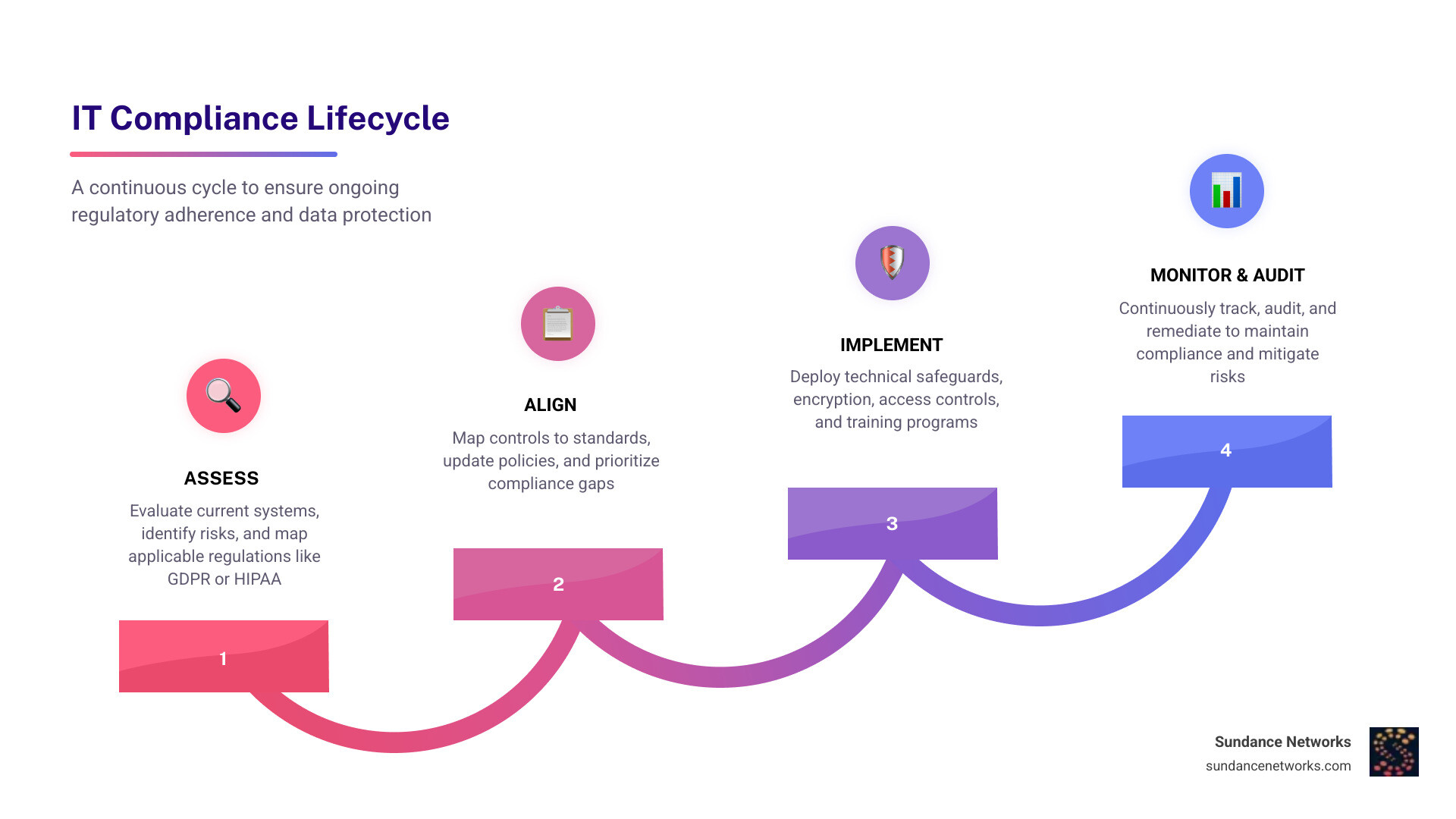
Achieving compliance isn’t a one-time event; it’s a continuous cycle. If you’re starting from scratch or auditing your current state, here are the essential pillars:

- Access Control: Who has the keys to the kingdom? You must implement “least privilege” access, ensuring employees only see the data they need for their jobs. Multi-factor authentication (MFA) is no longer optional in 2026; it’s a requirement.
- Incident Response: Do you have a plan for when things go wrong? You need a documented process for detecting, reporting, and responding to security incidents.
- Disaster Recovery: If a server in Reading, PA, goes down, how fast can you get back up? Compliance requires proof that your data is backed up and recoverable.
- Data Classification: You can’t protect what you don’t know you have. Categorize your data based on sensitivity (e.g., Public, Internal, Confidential, Restricted).
- Encryption Standards: Data should be encrypted both “at rest” (on the hard drive) and “in transit” (moving across the internet).
- Policy Documentation: If it isn’t written down, it didn’t happen. You need clear, written policies for everything from password management to remote work.
- Monitoring and Logging: You need a digital paper trail. Continuous monitoring ensures you can see who accessed what and when.
For specialized help in the medical field, our HIPAA Compliance Consulting provides a structured path to meeting these requirements.
Reducing Risks Through IT Compliance Automation
One of the biggest shifts we’ve seen leading up to 2026 is the move away from manual spreadsheets toward automation. Manual audits are slow, prone to human error, and are outdated the moment they are finished.
Automation tools allow for Policy as Code, where your compliance requirements are written directly into your system configurations. This enables continuous monitoring and drift detection. If a setting is changed that makes a server non-compliant, the system can automatically flag it or even “self-heal” by reverting the change. Organizations using modern compliance platforms have reported achieving certifications up to 90% faster and reducing audit preparation efforts by 60%.
In regions like Reading, PA, businesses are increasingly using these tools to maintain audit readiness year-round. For more on how to integrate these high-tech solutions, consider Strategic IT Support & Managed Cybersecurity In Reading, PA.
Best Practices for Achieving Continuous Compliance
To move from “reactive” to “proactive,” we recommend these five best practices:
- Regular Risk Assessments: Conduct an honest, holistic assessment of your environment at least once a quarter. Identify where your sensitive data lives and what threats it faces.
- Stakeholder Training: Your employees are your first line of defense—or your weakest link. Regular training on phishing, password hygiene, and data handling is essential.
- Internal Audits: Don’t wait for a third-party auditor to find a problem. Conduct your own “spot checks” to ensure policies are being followed.
- DevSecOps Integration: Bring your IT, security, and development teams together. When compliance is built into the development process from day one, it’s much cheaper and easier than trying to bolt it on later.
- Vendor Management: You are responsible for the compliance of your partners. If you use a cloud provider, ensure they have the necessary certifications (like SOC 2) to protect your data.
Frequently Asked Questions about IT Compliance
What are the common consequences of non-compliance?
The consequences can be severe. Financial penalties are often the first thing people think of—fines for GDPR or HIPAA violations can reach into the millions of dollars. However, the reputation damage can be even worse. Once customers lose trust in your ability to keep their data safe, they are likely to take their business elsewhere. You may also face legal action from affected parties and significant operational disruption while you scramble to fix the issues.
How often should an organization conduct IT compliance audits?
While most regulations require an annual review, we recommend a continuous monitoring approach. In 2026, the speed of change in IT is too fast for annual audits to be sufficient. You should also perform trigger-based assessments whenever there is a major change to your infrastructure, such as moving to a new cloud provider or opening a new office in Rio Rancho, NM.
Can automation completely replace manual compliance audits?
Not entirely. Automation is incredible for efficiency gains and evidence collection, but it cannot replace human oversight. You still need a human expert to perform strategic analysis and make high-level decisions about risk tolerance. We advocate for a hybrid approach: let the machines do the repetitive monitoring and data gathering, while the experts handle the complex interpretation and strategy.
Conclusion
Navigating IT compliance can feel like walking through a maze, but you don’t have to do it alone. At Sundance Networks, we specialize in providing smart technology, scalable AI, and robust security solutions that keep businesses of all sizes safe and compliant. Whether you’re looking for Managed IT Solutions & Cybersecurity for Santa Fe, NM or need help with Custom IT Consulting and System Integration, our team is here to empower your business.
By focusing on risk mitigation and community-centric service, we help you turn compliance from a burden into a business advantage. Let’s make your digital infrastructure as safe as a well-guarded factory—hard hats and all!